


Ever since I was a child, I have had this strange obsession with putting everything into the context of numbers. While other children were busy doing normal things, my brain was usually occupied with questions like, “How many ants do I need to stack to reach the moon?1” or “How many kilograms of food have humans eaten since the beginning of time?2”
One of the side effects of this lifelong obsession3 is that I can now approximate pretty much anything. It is a trick I still use to surprise my fiancée, who routinely (and unsuccessfully) tries to stump me with impossible questions.
You know those infamous hedge fund or Big Tech interview questions? The ones that most candidates find either scary or dumb, like, “How many golf balls fit inside a Boeing 747?” or “How many windows are there in Tokyo?”4 While they are a nightmare for most people… To me, this is just a fun Tuesday afternoon.
Being pathologically good at estimating is not just a party trick; it is a legitimate skill. It takes a world that is usually blurry and qualitative and snaps it into sharp, quantitative focus. It is one of the most versatile mental tools you can master.
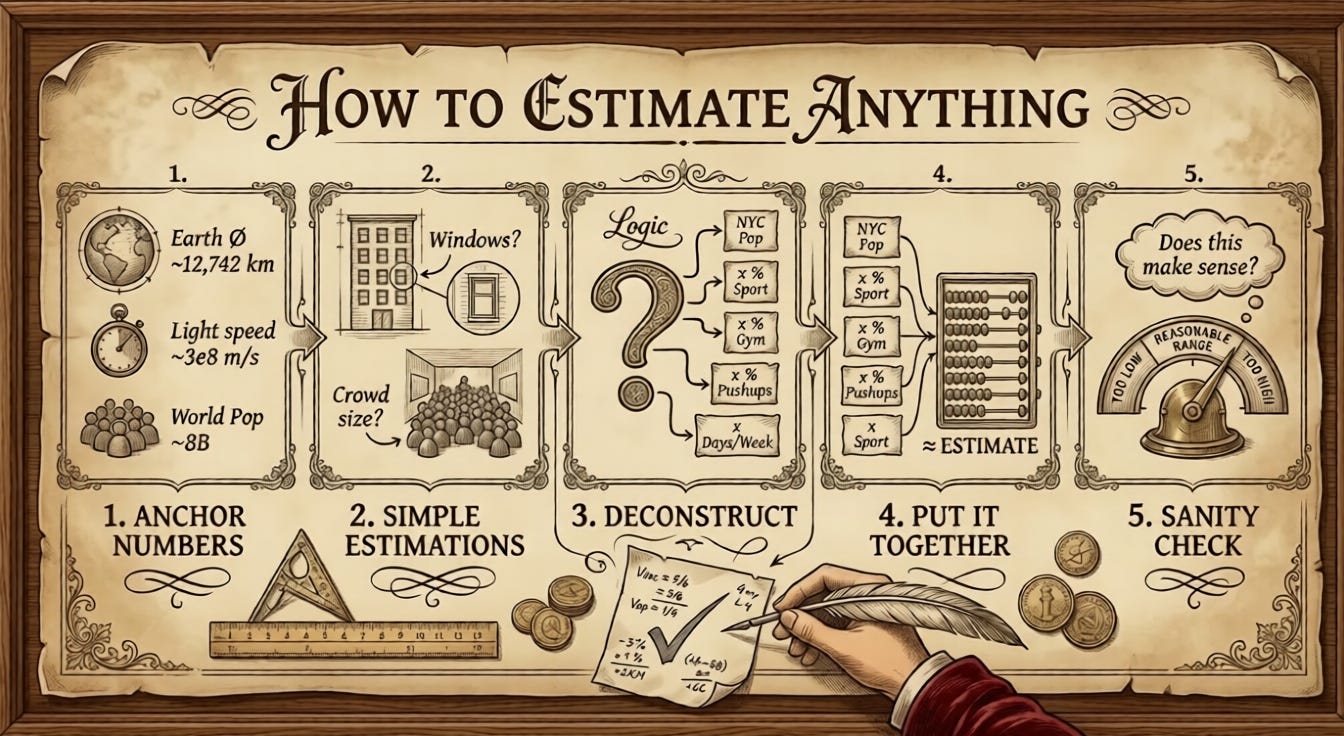
So today, I want to map out exactly how this works. If you spend enough years putting numbers on things, you realize the math is actually the easy part. The hard part is knowing how to break the universe down into pieces. Here is how you can take a massive, blurry universe and approximate practically anything in five steps.
As a bonus, once you are done internalizing your new skills, I made a mini-game to go with this post. Head over to the Bonus 1 section to test yourself.
1) Know your Anchor Numbers
You can’t navigate the dark without lighthouses, and you won’t be estimating anything if you don’t have a few hard facts to anchor your math to reality.
There is no magic trick to acquiring these. You just have to cultivate a habit of being a little too curious. You become the kind of person who occasionally Googles, "What is the diameter of the Earth?" or "What is the total GDP of the world?" while waiting in line for coffee.
The golden rule here is that the order of magnitude is everything, and exactness is useless. You don’t need to know that the population of the United States is exactly 334,914,895. "330 million" is great. "About 300 million" is perfectly fine. But if you think it is 3 billion, you have accidentally annexed several continents, and your math is doomed. You just want to be able to put reality into the right buckets5.
This habit alone already gives you an instant upgrade to your bullsh*t radar. For instance, if someone, say the president of a major North American country for the sake of example, were to claim they generated $10 trillion in new investment in just six months, you can call bullshit on the spot. Since you know the annual economic output of the entire planet is $100 trillion, you know this guy probably didn’t just casually manifest 10% of the world’s economy over the summer.6
Here are a few essential "Anchor Numbers" you should permanently memorize:
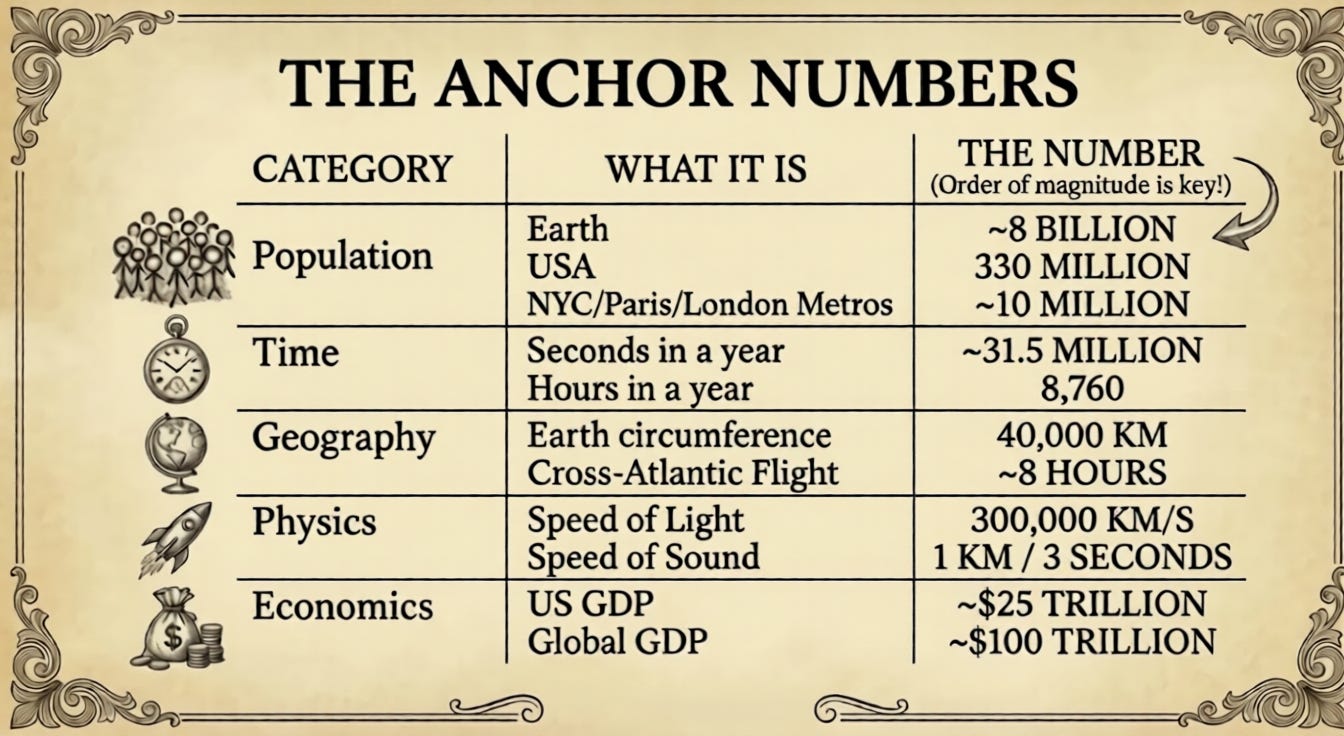
(Note: I put together a master cheat sheet of the 100 of the most important Anchor Numbers to help you estimate anything. Scroll down for the full visual list and a PDF download link at the bottom of this post)
2) Master the Simple Estimations
The second step is getting very good at estimating simple things. Just like anything else, you train this muscle by doing it regularly. You just start quietly putting numbers on your surroundings: How many people are crammed into this coffee shop? How many windows are on that skyscraper? How many dogs live in my apartment building? How big is the GDP of Tanzania?
Make a quick, educated guess, and then immediately check reality to see how wrong you were.
What you are doing here is calibrating your brain. You are developing an estimation “taste” or “instinct.” The exact number still does not matter. You just want to reach a point where you can look at the physical world and instantly fire off a reasonable, order-of-magnitude ballpark guess.
The best part is that this creates a compounding flywheel. Every time you figure out a random quantity, like the daily foot traffic of a coffee shop, it gets deposited into your mental library as a brand new Anchor Number. The more you estimate, the richer your baseline reality becomes, you start reusing old estimates to build new ones, making every future calculation exponentially faster and more accurate.
3) Break the Complexity Down into Simple Parts
If someone asks you an absurdly broad question, many people freeze unable to find a good angle. But a complex estimate is usually just a few simple estimates stacked together.
Let’s say you want to figure out: How many people will do pushups in Paris today?
If you try to guess that outright, you are just throwing darts blindfolded. But if you deconstruct it into a funnel, it just becomes a series of easy guesses:
The Base: How many people live in Paris? (Anchor Number: ~9 million)
The Active: What percentage of them exercise? (Simple estimation: ~50%7)
The Routine: Of that group, what percentage do strength or bodyweight training? (Simple estimation: ~30%)
The Pushup: Of that group, what percentage actually do pushups? (Simple estimation: ~50%)
The Frequency: How many days a week do they do them? (Simple estimation: About 2 days a week)
By breaking it down, you have taken a hopelessly broad question and turned it into five very simple ones. You just need to figure out those smaller estimates, and the big answer will reveal itself.
4) Crunch the Numbers
The fourth step is to actually crunch the numbers.
You take the funnel you just built and start plugging in the values. Use your Anchor Numbers wherever possible. When you are missing a piece of data, use your simple estimation muscle to bridge the gap.
You do not need a math degree for this part. The beauty of this framework is that the math itself is aggressively simple. You will never need a complex formula. 99% of the time, the entire problem can be unlocked with just basic, back-of-the-napkin addition, subtraction, multiplication, and division.
For this specific funnel, you literally just multiply down the chain. Let’s run the math on our Paris example:
9 million (Base) × 50% (Active) × 30% (Routine) × 50% (Pushup) × 30% (Frequency) = ~200,000 people.
Just like that, you pulled a highly specific, totally plausible number out of thin air.
Math tip: Round aggressively. The goal here is being roughly right, not perfectly accurate. If your funnel asks you to calculate 12% of 8,300, just find 10% of 8,000 and move on. Leave the exact math to the accountants.
5) Sanity Check the Result
The final step is to sanity check your work.
You must always verify your final answer against common sense. Do not trust your numbers blindly. If you are not careful, small estimation errors can compound into an absolutely absurd final result. This is where your Anchor Numbers come back to save you.
The best way to do this is to build a sanity range in your head. You just ask yourself what the absolute lower and upper bounds could possibly be before the number becomes completely illogical.
For example, look at our Paris pushup estimate. If your final math spit out 20 million, something is clearly broken since your Anchor Number for the entire population of Paris is only 9 million. On the flip side, if your estimate was 100 people, that also completely fails the smell test for a major metropolis.
A logical lower bound might be 1,000 and a realistic upper bound might be 2 million. Since our estimate of 200,000 sits comfortably inside that range, the math passes the sanity check.
A Practical Example: The Global Forest
Let us put it all together with a question about the natural world:
How many trees are there on Earth? 🌳🌲🌴
Guessing that outright is just throwing darts blindfolded. But if we use our framework to break the complexity down into simple parts, the answer will reveal itself.
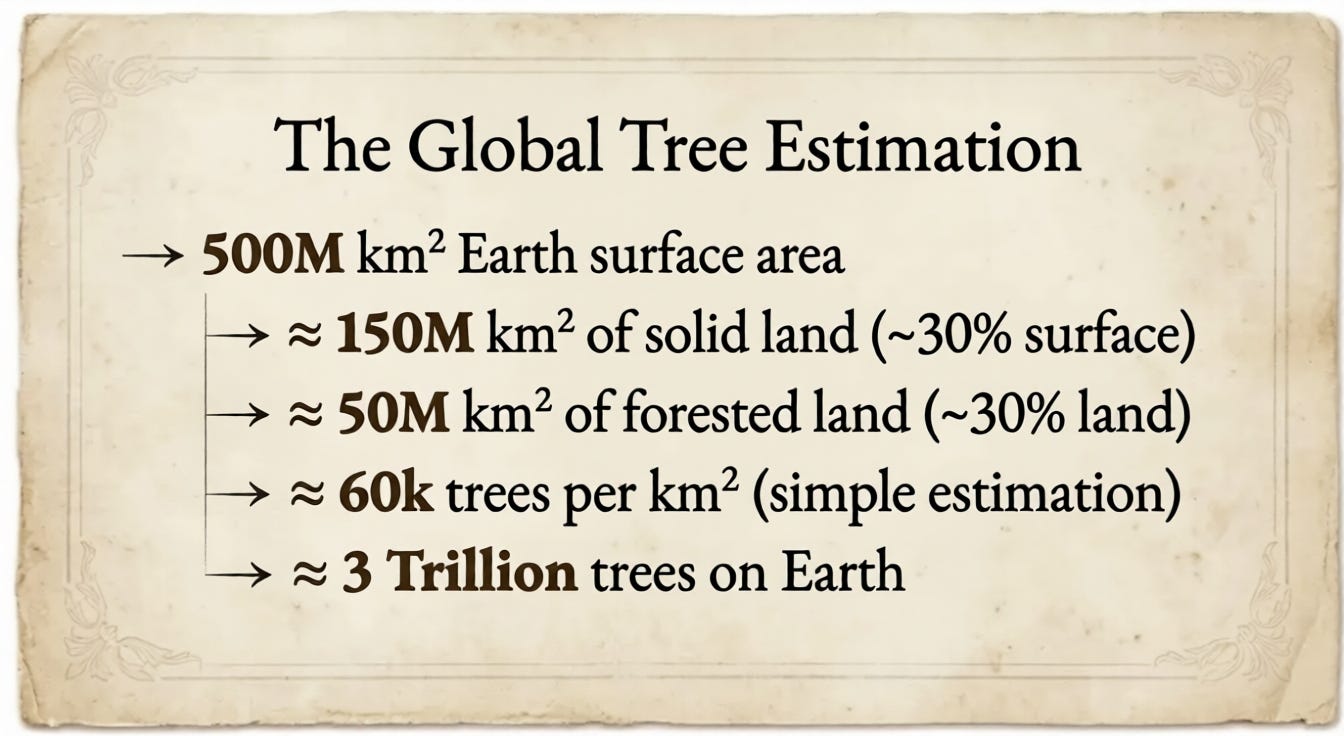
The Base (Anchor Number): What is the total surface area of the Earth? You pull this straight from your mental library: ~500 million square kilometers.
The Land (Simple Estimation): We know Earth is mostly water. Land makes up roughly a third of the surface. That gives us 150 million square kilometers of solid ground.
The Forest (Simple Estimation): What percentage of that land actually grows trees? Picture a globe. You have to subtract Antarctica, the Sahara desert, massive mountain ranges, the frozen tundra, and endless grassy plains. A reasonable guess is that maybe a third of the remaining habitable land is heavily forested. Call it 30%. That leaves us with 50 million square kilometers of forest.
The Density (Simple Estimation): This is the missing link. How many trees fit in a single square kilometer? To visualize this, picture walking through a typical woodland. How far apart are the tree trunks? Some are clustered, but to give the canopies room to catch sunlight, an average distance of about 4 meters apart feels right. That means one average tree claims a 4-by-4 meter patch of ground, or 16 square meters.8
Crunch the Numbers: Now we do the math. One square kilometer is exactly 1 million square meters. If we divide 1,000,000 by 16, we get roughly 60,000 trees per square kilometer.
Then, we just multiply that by our total forest area: 50 million square kilometers × 60,000 trees = 3,000,000,000,000.
So the answer is:
There are roughly 3 trillion trees on Earth.
Fun fact: The mass of trees and other plants makes up about 82% of the mass of all living things on Earth. Meanwhile, all 8 billion humans combined account for just 0.01%. We like to think we are the main characters of this planet, but mathematically speaking, human civilization is basically just a rounding error in a giant wooden empire.

Last but not least, sanity check the result. Three trillion might sound completely made up at first. But if we verify it against another Anchor Number (the global human population of ~8 billion), it works out to about 400 trees for every person alive. Given the sheer, sprawling size of places like the Amazon, the Congo basin, and the Siberian taiga, that ratio actually feels incredibly grounded.
And if you check the hard data, a massive 2015 study from Yale University using satellite imagery arrived at almost the exact same number: 3.04 trillion.
In Defense of Overthinking It
I think this ability to deconstruct complex ideas into simple quantities is the real reason I love approximating. People often assume that quantifying everything makes the world cold, robotic, and stripped of its magic. But it actually does the opposite.
When you learn to approximate, the universe stops being an intimidating, opaque blur. Big, complex, impossible-to-grasp things suddenly become approachable. You realize that everything, from the macroeconomics of a metropolis to the micro-habits of your friends, can be deconstructed, understood, and wrangled into a manageable concept.
You don’t need to be perfectly accurate. You just need a decent Anchor Number, a bit of logic, and the right order of magnitude.
The universe is a lot less intimidating when you realize you can just put a number on it. And usually, it is a lot more entertaining, too.
Now it is your turn. Go look out a window and put a number on something. Have fun!
Bonus 1: The Estimation Game
I built a quick interactive game to test your new capability. You will be faced with a series of random questions where the goal is simply to guess the correct order of magnitude.
Head over to satpugnet.com/playground/estimation-game/ if you want to test your abilities.
Bonus 2: The Cheat Sheet
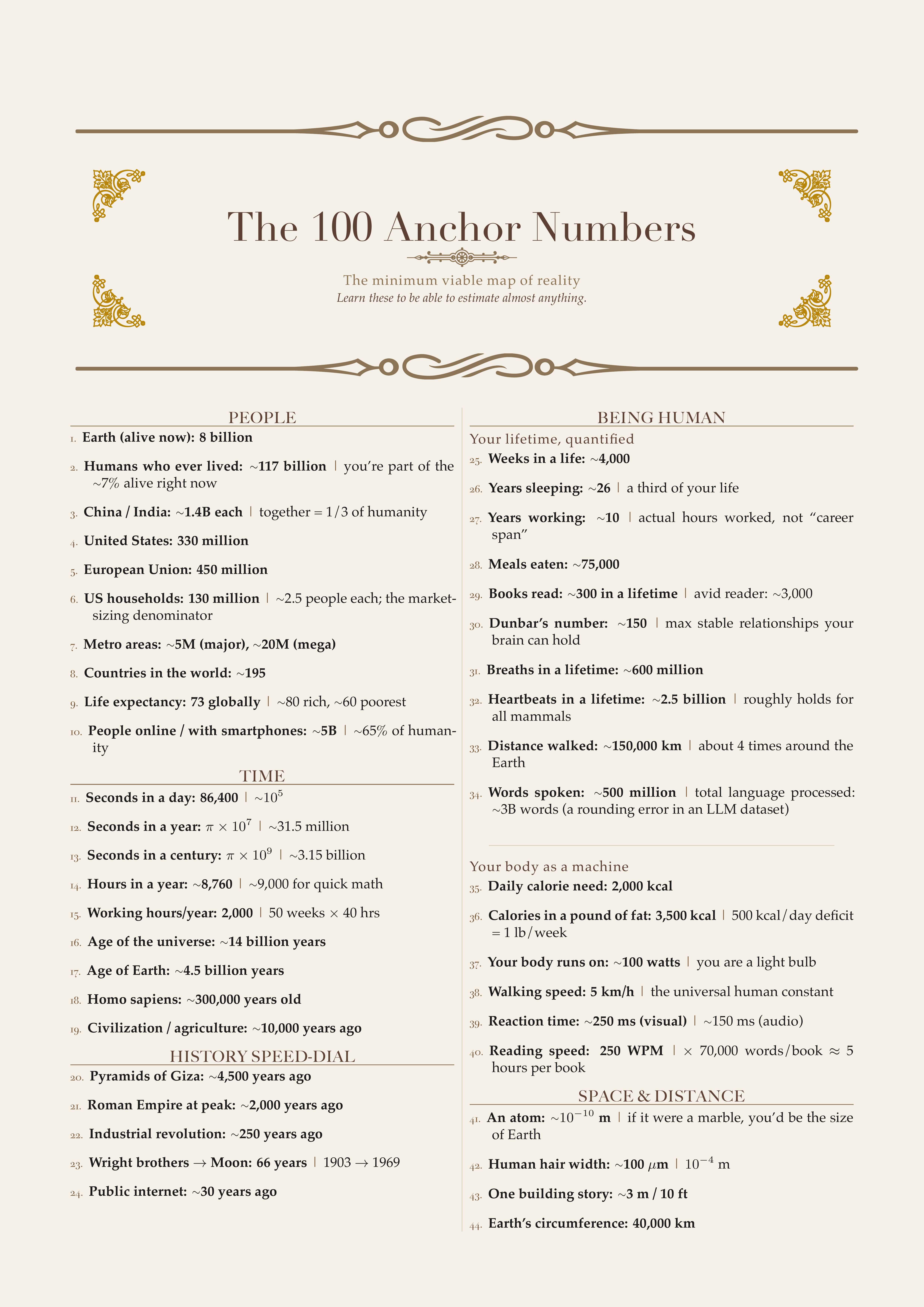
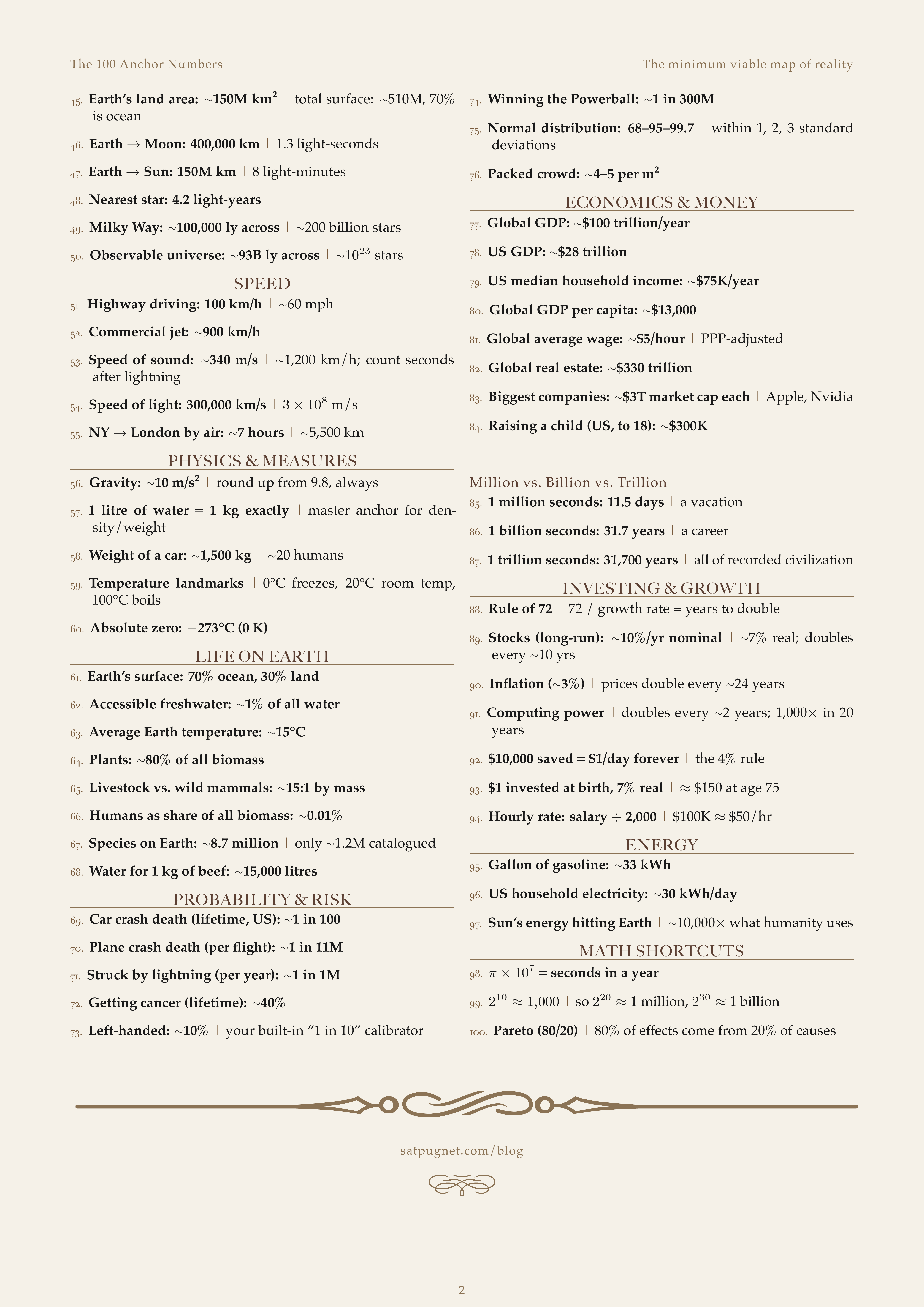
Full pdf downloadable here:

In case you were wondering: it takes roughly 170 billion ants to reach the moon (assuming an average ant length of 2.3mm and a very cooperative vertical stack). Since there are about 20 quadrillion ants on Earth, we actually have enough biological inventory to make 50,000 round trips. I didn’t just calculate this for the essay; I actually did the math when I was nine. As you can imagine, I was socially unstoppable.
1.5 quadrillion kilograms. Or about 150,000 Great Pyramids of Giza.
I owe most of this to my dad. He used car rides to teach me that the universe is just a big collection of things waiting to be counted, and that no mystery is too big for a quick back-of-the-napkin calculation.
For the nerds in the room: these are usually called Fermi problems or Fermi estimates, though humans were doing this kind of thing long before anyone decided to give it an Italian physicist’s name.
Our World In Data is the absolute gold standard for curious people looking for Anchor Numbers, I strongly recommend exploring it if you don’t already know it.
Any resemblance to persons living or dead is purely coincidental. 🙃
That’s right, us French are very active. You would be surprised by the caloric burn required to sustain our baseline level of cultural snobbery.
As a French person living in New York, I am morally obligated to use meters. But for my American friends who stubbornly refuse the metric system and prefer to measure distance in bald eagles per monster truck: 4 meters is about 13 feet, or roughly the length of one standard sedan.